

Back to blog
Filter by:
Tags
- Knowledge
- technology
- OOP
- Tips
- Programming
- Tips
- Tutorial
- SEO
- Ranking
- Knowledge
- Special Day
- Seo
- Bug
- Data science
- Seo
- artificial intelligence
- Machine Learning
- Robotics
- happyNewYear2021
- newYearEve
- 2021
- Automation
- Smart Home
- Career
- Best Practices
- Git
- Logging
- Web Fundamentals
- DNS
- HTTPS
- Performance
- AI Tools
- ChatGPT
- Claude
- Gemini
- Laravel
- Eloquent
- MySQL
- HTTPS
- TLS
- Web Security
- Certificates
- Developer Life
- Debugging
- Docker
- DevOps
- Transactions
- Queues
- LLMs
- AI
- AI Coding
- Developer Tools
- React Native
- Expo
- Kate PMS
- Mobile Apps
- Laravel
- Authentication
- Sanctum
- Cookies
- API Design
- Payments
- Idempotency
- DeepSeek
- Open Source AI
- LLMs
- AI News
- Git
- Version Control
- AI Coding
- Prompting
- PHP
- Checklist
- MCP
- AI Agents
- OpenAI
- Architecture
- Microservices
- Modular Monolith
- Estimation
- Developer Life
- Project Planning
- Humour
- OAuth
- OpenID Connect
- Authentication
- Embeddings
- Vector Search
- RAG
- pgvector
- OpenAI
- GPT-4.1
- Codex CLI
- Events
- Testing
- Clean Code
- Maintainability
- Code Review
- Webhooks
- API
- Security
- Claude Code
- Workflow
- AI
- LLM
- Prompt Injection
- Mobile
- React
- Networking
- TCP
- UDP
- HTTP/3
- CLAUDE.md
- AWS
- Cloud Security
- Backups
- PHPUnit
- Software Engineering
- Leadership
- Communication
- RAG
- Embeddings
- AI Engineering
- IT Infrastructure
- Networking
- Access Control
- CI/CD
- GitHub Actions
- Gemini CLI
- Claude Code
- JavaScript
- Async/Await
- Node.js
- Promises
- Security
- Cryptography
- Passwords
- MySQL
- Database
- Vibe Coding
- Software Quality
- DNS
- Code Reading
- Onboarding
- Productivity
- Background Jobs
- Developer Humour
- Estimates
- Dev Life
- JWT
- o3-mini
- DeepSeek R1
- Rate Limiting
- Kate PMS
- E-Signing
- Audit Trail
- REST
- GraphQL
- API Design
- Laravel 12
- Upgrade Guide
- Open Source
- Self-Hosting
- Task Scheduling
- Cron
- Secrets
- CORS
- PHP
- PHP-FPM
- OPcache
- GitHub Copilot
- Software Architecture
- Engineering
- TypeScript
- JavaScript
- Type Safety
- AI Security
- React Native
- Product Design
- AI Agents
- Kiro
- Queues
- Redis
- RabbitMQ
- AWS SQS
- Nginx
- Apache
- GPT-5
- gpt-oss
- Clean Code
- Architecture
- Naming
- Documentation
- Career
- ADR
- Teamwork
- Supply Chain
- Kate HRM
- HR Software
- Permissions
- System Design
- Pagination
- SSH
- Linux
- Big O
- Databases
- Laravel Boost
- MCP
- Developer Skills
- Validation
- Databases
- Indexes
- Code Quality
- Deployment
- Developer Humour
- Feature Flags
- Code Review
- Pull Requests
- Docker
- Cursor
- Authorization
- RBAC
- Gemini
- Long Context
- PHP 8.4
- Caching
- Dependency Injection
- Web Performance
- Browser
- CSS
- Database
- Migrations
- ChatGPT
- AI for Developers
- Monitoring
- On-Call
- REST
- Backend
- SQL
- NoSQL
- Database Design
- Coding Agents
- Claude 4
- API Resources
- REST API
- Load Balancing
- Scaling
- AWS
- AI Tools
- Claude
- Sora 2
- CTE
- 2FA
- TOTP
- Programming Languages
- Prompts
- Developer Workflow
- API Gateway
- APIs
- Passport
- API Auth
- Learning
- Burnout
- Developer Growth
- Web Development
- SEO
- Kate Mall
- ChatGPT Atlas
- Agent Skills
- Middleware
- Laravel 12
- Collections
- Context Window
- Monitoring
- Commit Messages
- Self Review
- Growth
- Regex
- Programming Basics
- Text Processing
- Database Design
- Normalization
- Linux
- Server Security
- Linux Foundation
- Open Standards
- Legacy Code
- Documentation
- AI Workflow
- File Uploads
- Test Data
- Hashing
- Performance
- Caching
- Enums
- Scope Creep
- Estimation
- Codex
- Gemini CLI
- Timezones
- Carbon
- Bugs
- PHP 8.5
- Gemini 3
- GPT-5.1
- Data Integrity
- Event Loop
- Async
- Opus 4.5
- AI Models
- React
- Forms
- Frontend
- Backups
- AI Images
- DALL-E
- Midjourney
- Race Conditions
- Concurrency
- Legacy Code
- Refactoring
- Senior Engineer
- Scope
- LLM
- CDN
- Web
- Sub-Agents
- Soft Deletes
- Audit Log
- Concurrency
- AI Learning
- NestJS
- AI Evals
- Policies
- SPF DKIM DMARC
- Unicode
- UTF-8
- Knowledge Graph
- Value Objects
- Technical Debt
- Feature Flags
- Laravel Pennant
- Deployment
- Copilot
- Composer
- Dependencies
- Artisan
- Automation
- AWS S3
- Object Storage
- Cloud
- Small Language Models
- Ollama
- Production
- Sessions
- HTTP
- Mentoring
- SQL
- Virtual Machines
- Web Development
- HTTP/2
- QUIC
- Web Performance
- AI Integration
- LLM API
- SOLID
- OOP
- Hosting
- Serverless
- Merge Conflicts
- Temperature
- AI Development
- Reverse Proxy
- Nginx
- Infrastructure
- Verification
- Passkeys
- WebAuthn
- Teams
- Communication
- Stakeholders
- Monorepo
- CI/CD
- Versioning
- JSON Schema
- Livewire
- Inertia
- Meetings
- Distributed Systems
- Privacy
- Full-Stack
- T-Shaped Skills
- Money
- Notifications
- Web Security
- HTTP Headers
- CSP
- Function Calling
- Load Testing
- k6
- Data Extraction
- Debugging
- WebSockets
- SSE
- Real-Time
- Laravel Reverb
- Infrastructure as Code
- Terraform
- Side Projects
- Laravel Pint
- OpenAPI
- Swagger
- UX
- Multimodal
- Jest
- Pair Programming
- APIs
- Rate Limiting
- Resilience
- Dev Humour
- Design Tokens
- JWT
- API Keys
- Sessions
- PHPStan
- Rector
- Incidents
- Reporting
- Dashboards
- Zero Trust
- IAM
- Search
- Laravel Scout
- Junior Developers
- Mentoring
- Images
- WebP
- AVIF
- Bug Reports
- Let's Encrypt
- Design Docs
- Software Design
- Observers
- Replication
- Accountability
- Data Structures
- Reliability
- LLM Memory
- Error Handling
- Payments
- Payment Gateway
- Webhooks
- PCI DSS
- Observability
- OpenTelemetry
- Personal Brand
- Writing
- Conventions
- Dates
- Scheduling
- Disaster Recovery
- Compression
- Brotli
- Deadlines
- Developer Habits
- State Machines
- Tech Roles
- UUID
- ULID
- Horizon
- Planning
- Engineering Culture
- Ownership
- Soft Skills
- Socialite
- Cost Control
- Collations
- Unicode
- Octane
- PostgreSQL
Categories
//Article title
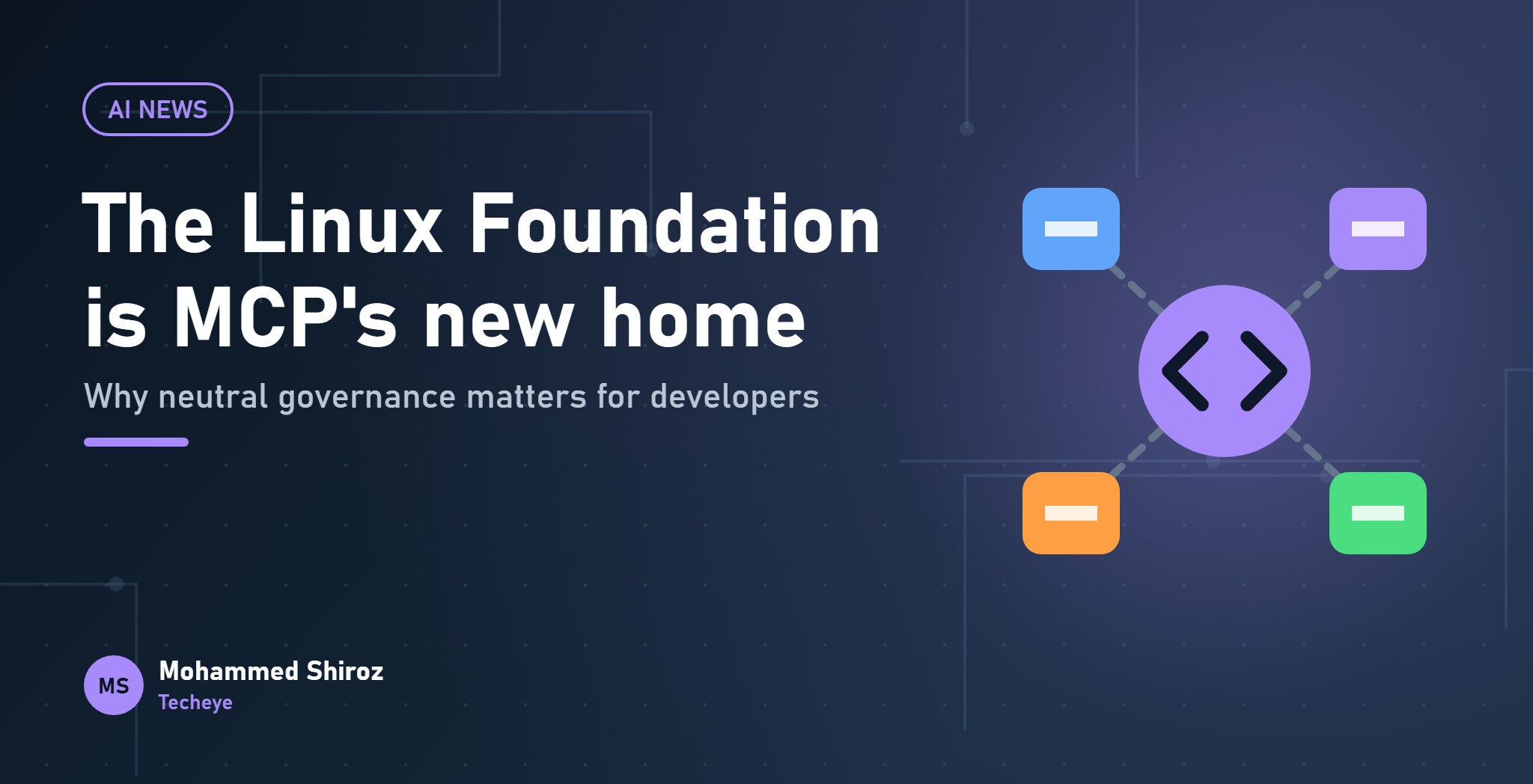
MCP Joins the Linux Foundation: Why It Matters for Developers
About Post
A year ago, the Model Context Protocol was one company's idea for connecting AI models to tools. This month, it stopped belonging to that company.
On 9 December 2025, Anthropic donated MCP to the Agentic AI Foundation, a new directed fund under the Linux Foundation, which it co-founded with OpenAI and Block. If you build anything that connects AI to real systems, that's a quiet but important piece of news. Here's what happened, why it matters, and what it does (and doesn't) change for developers.
First, a 30-second refresher on MCP
MCP is an open protocol that lets AI applications talk to external tools and data in a standard way. An MCP server exposes capabilities, like "search the docs", "query this database" or "create a ticket". An MCP client, inside an AI app or coding agent, discovers those capabilities and lets the model call them.
The usual analogy is USB-C. Before it, every device had its own cable. Before MCP, every AI tool had its own way of plugging into GitHub, Slack, your database or your app. With MCP, you build the connector once and any compatible client can use it.
Anthropic introduced it in November 2024. Through 2025 it spread fast: OpenAI adopted it in March, and today it's supported across a wide range of assistants, coding agents and editors. Framework-specific servers appeared too, such as Laravel Boost for Laravel apps.
What actually happened
- Who: Anthropic, the company that created MCP.
- What: donated the protocol to the Agentic AI Foundation.
- Where: the foundation is a directed fund under the Linux Foundation, co-founded by Anthropic, OpenAI and Block.
- When: 9 December 2025.
- Why it matters: MCP is now governed as an open standard by a neutral organisation, rather than owned by a single AI company.
Why neutral governance is a big deal
An open specification and an open standard are not quite the same thing. Anyone could read and implement MCP from day one. But as long as one company owned it, every competitor adopting it had to trust that the owner wouldn't steer it in a direction that suited only themselves.
Moving it to a neutral home changes that conversation. This pattern has played out before in our industry. Kubernetes was created at Google and handed to the Cloud Native Computing Foundation, part of the Linux Foundation, and it became the default way to run containers across every major cloud. Node.js found a neutral home in a foundation too. Neutral governance is often what turns "a good technology from one vendor" into "the thing everyone builds on".
The fact that OpenAI co-founded the foundation is the signal to notice. Competitors sharing a standard is how ecosystems grow; competitors each pushing their own protocol is how developers end up writing the same integration three times.
The short version: MCP was already the closest thing AI tooling had to a common plug. Now it has a neutral owner, which makes it a much safer bet to build on for the long term.
What changes for developers
If you build MCP servers
Nothing breaks. The protocol you implemented last week is the same protocol today. What changes is confidence: an MCP server you build for your product or internal system is more likely to keep working across clients, including ones that don't exist yet.
If you've been holding off on exposing your API or internal tools to AI agents because the standards felt unsettled, this is a reasonable moment to stop waiting.
If you use AI coding tools
You probably won't notice anything directly. Indirectly, it's good news: the connectors you set up (for your issue tracker, database, docs or framework) are more likely to work across Claude Code, ChatGPT, Copilot, Cursor and whatever you use next year. Less lock-in, more choice.
If you lead a team
Open governance makes MCP an easier conversation with security and procurement teams. "We're adopting an open standard under the Linux Foundation" lands differently than "we're adopting a vendor's protocol".
What doesn't change
A neutral owner doesn't make your MCP servers secure. That part is still on you, and it's where I'd focus attention:
- Least privilege. An MCP server with full database write access gives every connected agent full database write access. Expose the smallest useful set of tools, read-only where possible.
- Prompt injection. Data an agent reads through a tool (an issue, an email, a web page) can contain instructions aimed at the model. Treat tool output as untrusted input.
- Third-party servers. Installing an MCP server is installing software that an AI can drive. Review it like any other dependency.
- Human approval for anything destructive or expensive, regardless of which client is calling.
My take
Standards rarely make headlines, and this one won't trend for long. But I think this is one of the more important developer stories of the year. A year ago, connecting AI to your systems meant picking a vendor and hoping. Now there's a shared plug with a neutral owner, and that's usually the moment an ecosystem starts to grow up.
The official MCP site is the best place to start if you want to build a server of your own.
Are you running any MCP servers in your workflow yet? I'm curious which integration people found most useful first: docs, database, issue tracker, or something else.
01. About Shiroz

Mohammed Shiroz
Hi, I'm Mohammed Shiroz, a software engineer and AI enthusiast from Sri Lanka who turns ideas into intelligent, real-world solutions. With over 9 years of hands-on experience, I currently lead real estate ERP development at Kate Group, a...
02. Latest Posts

03.My Projects






 Jordan
 Pakistan
 United States
 Saudi Arabia
 Russian Federation
 Croatia
 United States
 Netherlands
 Sri Lanka
 Cyprus
 Russia
 Israel
 France
Be first to comment it...